Most second brains have one reader: you. The notes sit in an app, sorted in a way that makes sense to you, and get opened when you remember to open them. That's fine until half your thinking happens in a chat with an AI, and the AI can't see any of it.
This article covers what a second brain is, why most of them are invisible to the AIs you use, and what to change so an AI can actually use yours. Everything about third-party products was checked against their official pages on 14 October 2026.
What a second brain is
The term comes from Tiago Forte and his book Building a Second Brain. The idea is simple. You keep what you learn and decide outside your head, in a system you trust, so you can find it again when you need it.
His best known tool is PARA, which sorts everything into four groups. Projects are short-term efforts with a goal. Areas are parts of your work and life that need ongoing attention. Resources are topics you're interested in and learning about. Archives hold whatever from the first three is no longer active.
You don't need a particular app for any of this. People build second brains in Notion, in Obsidian, in Apple Notes, in plain folders on a drive. What makes it work is the habit.
Why your AI can't use it
Forte's method was designed for a human reader. Today a lot of the reading is done by an AI. You ask Claude to draft a proposal for a client, ChatGPT to write the follow-up email, a coding agent to fix the price list. All three would do a better job with what's in your notes, and usually none of them can reach the notes.
There are two reasons for that.
The first is where the notes live. An AI that runs in the cloud can only reach what's on the internet. Anthropic's help center says Claude connects to remote MCP servers "from Anthropic's cloud infrastructure, rather than from your local device", and that the server must be reachable over the public internet. OpenAI's help center says ChatGPT connects only to remote MCP servers. A notes folder on your laptop is out of reach, which is the whole story of our article on Obsidian and Claude via MCP.
The second is that each AI keeps its own memory. Claude saves topics from your chats, which you can read and edit under Settings > Memory, and every project gets its own separate memory space. Anthropic is clear that this memory isn't shared automatically with other AI products: it moves only if you export it and import it by hand. ChatGPT keeps its memory inside ChatGPT. So what you told Claude on Monday, ChatGPT doesn't know on Wednesday. We cover both in how Claude's memory works and ChatGPT's memory.
Built-in memory is handy, and we wouldn't turn it off. But it isn't a second brain. You don't choose its structure, you can't open it as a set of files, and it belongs to one product.
What an AI needs from your notes
For notes to work for an AI as well as for you, a few things have to be true.
They need an address the AI can reach from where it runs. Today that means a remote MCP server. MCP, the Model Context Protocol, is the standard way an AI uses an outside tool, and Claude, ChatGPT, Claude Code and Codex all support it.
They should be plain text. Markdown is read by every AI and every editor. A proprietary format puts a conversion step between the AI and your notes, and between you and your notes on the day you leave.
The structure has to be something an AI can follow. An AI doesn't browse the way you do. It searches, opens a note and reads it. Folders per client or project, dates in file names and titles that say what happened all help it land on the right note at the first try.
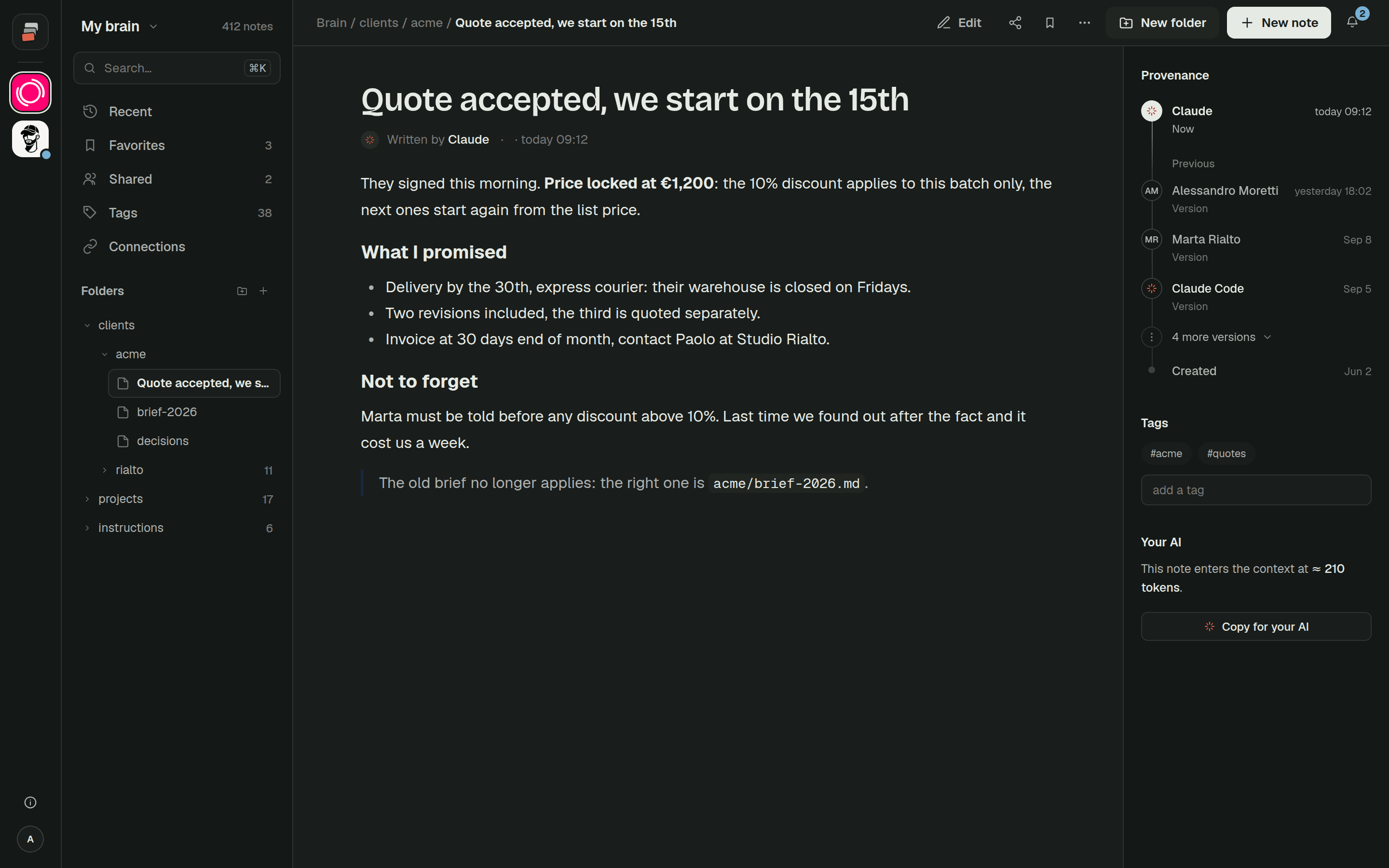
The AI should be able to write, and you should be able to undo. A second brain the AI only reads is half as useful: the value shows up when it writes down the decision you just made. Models get things wrong, though, so every change needs a record and a way back.
And someone has to tidy. A memory that keeps growing and is never cleaned gets worse over time, with the same fact written twice and an old decision sitting next to the new one.
How to write notes an AI can use
You don't need a new method. PARA works fine. A few habits make the difference.
Give each client, project or person a folder with a short card: who they are, the rules, what's been decided. When the AI opens the folder, it gets the picture before the details.
Write one note per working session, with the date in the file name and a title that states the fact. "Courier changed: express, never on a Friday" tells the AI something. "Update" tells it nothing. It reads the date from the name, the fact from the title and the rest from the text.
Keep the decisions for each project in one file, newest at the bottom. Then the AI doesn't have to guess which of two notes is current.
And ask the AI to write. At the end of a session, "write down what we decided" takes ten seconds. It's the difference between a memory and a pile of old chats.
Where Cobrain fits
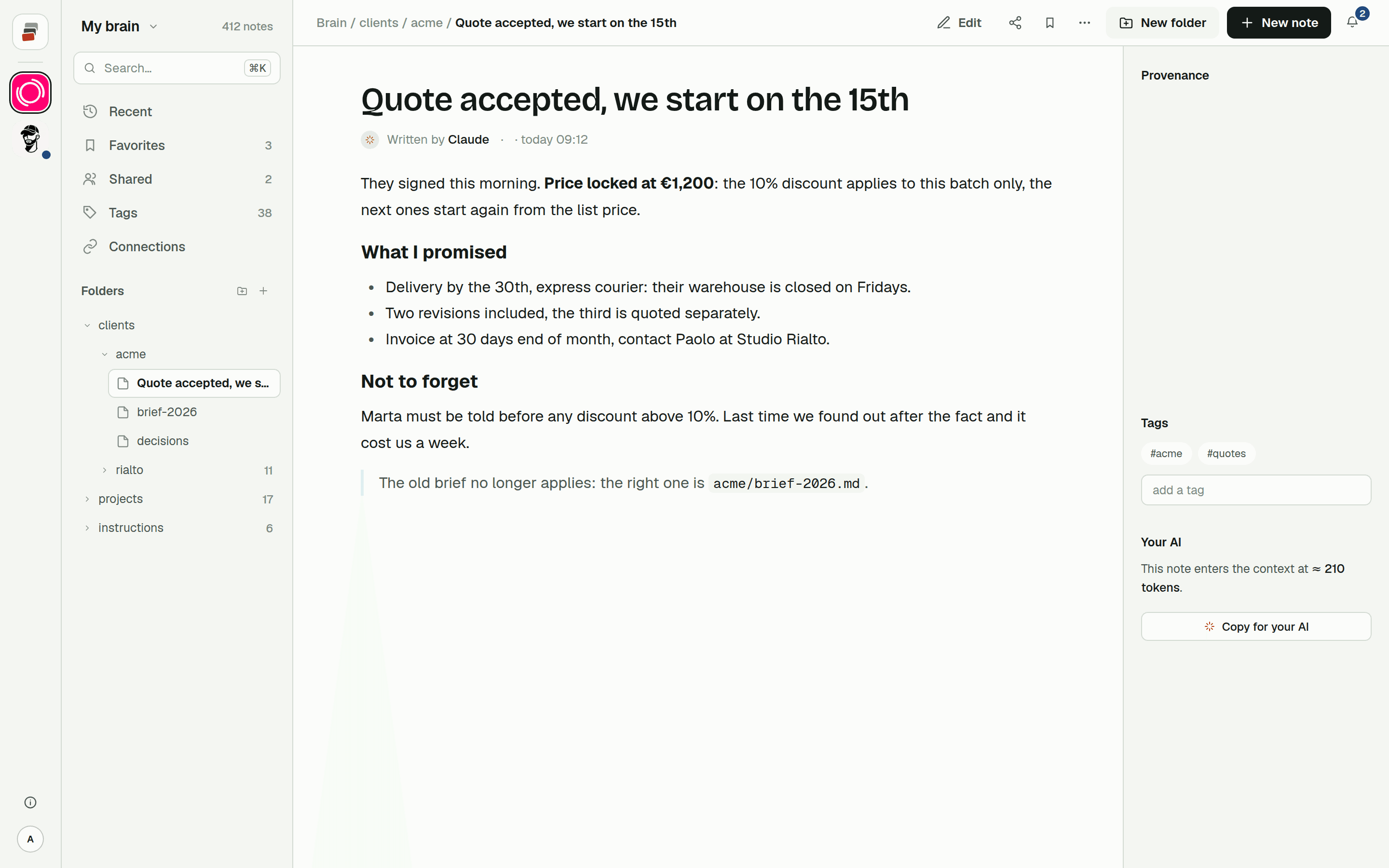
Cobrain is a second brain built for this. Your notes are Markdown files in real folders, with [[wikilinks]] and tags, behind a remote MCP address. You connect Claude, ChatGPT, Claude Code, Codex, Cursor and others to the same brain, and each one works with your permissions: it reads what you can read and writes where you can write.
Here's the example we use on the site. On Monday, in Claude, you agree with a client that deliveries go by express courier, never on a Friday, and Claude writes it in that client's decisions note. On Wednesday ChatGPT writes the delivery email and already knows. On Friday Claude Code is fixing the price list and finds a colleague's note about discount limits.
When a note changes, the previous version is kept, so a bad edit can be undone. The Dream, included in every plan, flags broken links and empty notes, and your AI helps you merge duplicates. Since the notes are plain files, they stay yours: you export everything whenever you want.
If you already have notes, you can bring them in as they are. If you don't, start from scratch. And if you're weighing options, the alternatives page puts them side by side.
Quick answers
What is a second brain? A system outside your head where you keep what you learn and decide, so you can find it later. The term was popularized by Tiago Forte, whose PARA method sorts notes into Projects, Areas, Resources and Archives.
Can ChatGPT or Claude be my second brain? Partly. Both remember things between chats, but each keeps its memory inside its own product, you don't control the structure, and they don't share it with each other. A second brain you own sits outside all of them.
Can my AI read my notes app? Only if the notes are reachable from where the AI runs. Claude and ChatGPT connect to remote MCP servers from the cloud, so notes stored only on your computer are out of reach from the web and from your phone.
How should I organize notes for an AI? A folder per client or project with a short card, one note per session with the date in the name, titles that state the fact, and one file for decisions.