Most teams don't pick one AI. One person lives in Claude, another writes everything in ChatGPT, the developer has Claude Code or Codex open in the terminal, and someone has just moved to Cursor. That's usually a reasonable choice: people use the tool that works for them.
The trouble shows up when they all work on the same client. Each AI has its own memory, tied to one person and one product, so what one of you settled on Monday is missing from everyone else's chat on Tuesday. This article looks at what the built-in memories of Claude and ChatGPT share inside a team, where that stops, and how to keep one memory that every AI on the team can read. Facts about Claude and ChatGPT were checked against Anthropic's and OpenAI's help centers on 21 October 2026.
Why every AI on the team remembers something different
Built-in memory follows two lines: the person and the product.
The person, because memory is attached to an account. In Claude, on Team and Enterprise plans, memory is enabled by the owners and then stays off for each member until they turn it on; after that, each person manages their own. Anthropic is explicit that owners can't view or edit an individual's memories. Nothing in the help center says that what your Claude learned reaches your colleague's Claude.
The product, because memory lives inside the app that collected it. ChatGPT doesn't read Claude's memory, Claude doesn't read ChatGPT's, and coding agents have their own files on top: Claude Code reads CLAUDE.md, Codex reads AGENTS.md. We compared those two in CLAUDE.md vs AGENTS.md.
Put the two lines together and a team of four on three AIs ends up with four or more separate memories about the same client. None of them is wrong. Each one just holds a piece of the picture.
What shared projects solve, and what they don't
Both Claude and ChatGPT let you share a project, and that helps. They set it up differently, though.
In Claude, project sharing is available on Team and Enterprise plans, only with members of your organization. People get "Can view", to read the knowledge and chat in the project, or "Can edit", to change instructions and knowledge too. Each project has its own memory, separate from other projects.
In ChatGPT, OpenAI's help center lists project sharing on every plan, Free included. You invite people by email or open the project to anyone with the link, and they get chat access or edit access. Shared projects use project-only memory: ChatGPT doesn't draw on a member's memories or instructions from outside the project.
So a shared project gives a group the same files and instructions, in one product. What it doesn't do is cross the product line. A Claude project is invisible to ChatGPT, and a ChatGPT project is invisible to Claude, Claude Code and Codex. If half the team is in one app and half in the other, you end up keeping two projects in sync by hand, which is exactly the job you were trying to hand over to the AI. We went through Claude's side in more detail in Claude Projects vs a shared memory.
The common ground: MCP
What the AIs do share is a protocol. MCP, the Model Context Protocol, is described by its maintainers as "an open-source standard for connecting AI applications to external systems". Claude, ChatGPT, Visual Studio Code and Cursor all support it, and so do Claude Code and Codex. Codex, for example, connects to remote servers over HTTP and logs in with codex mcp login, while Cursor reads its servers from a mcp.json file, global or per project.
That's what makes a team memory possible. If the notes sit behind one MCP server, every AI on the team can reach the same place, whichever app each person likes. The memory stops belonging to one product and starts belonging to the work.
What a team memory for different AIs needs
Reaching the same notes is the start. For a team, a few more things have to hold.
Permissions come first. When Marta's ChatGPT reads the client folder, it should see what Marta can see and nothing more; an AI that sees more than the person using it is a hole in the permission model. And sharing has to follow the work rather than the company, because clients, freelancers and partner agencies are part of most real projects and rarely sit in your organization's account.
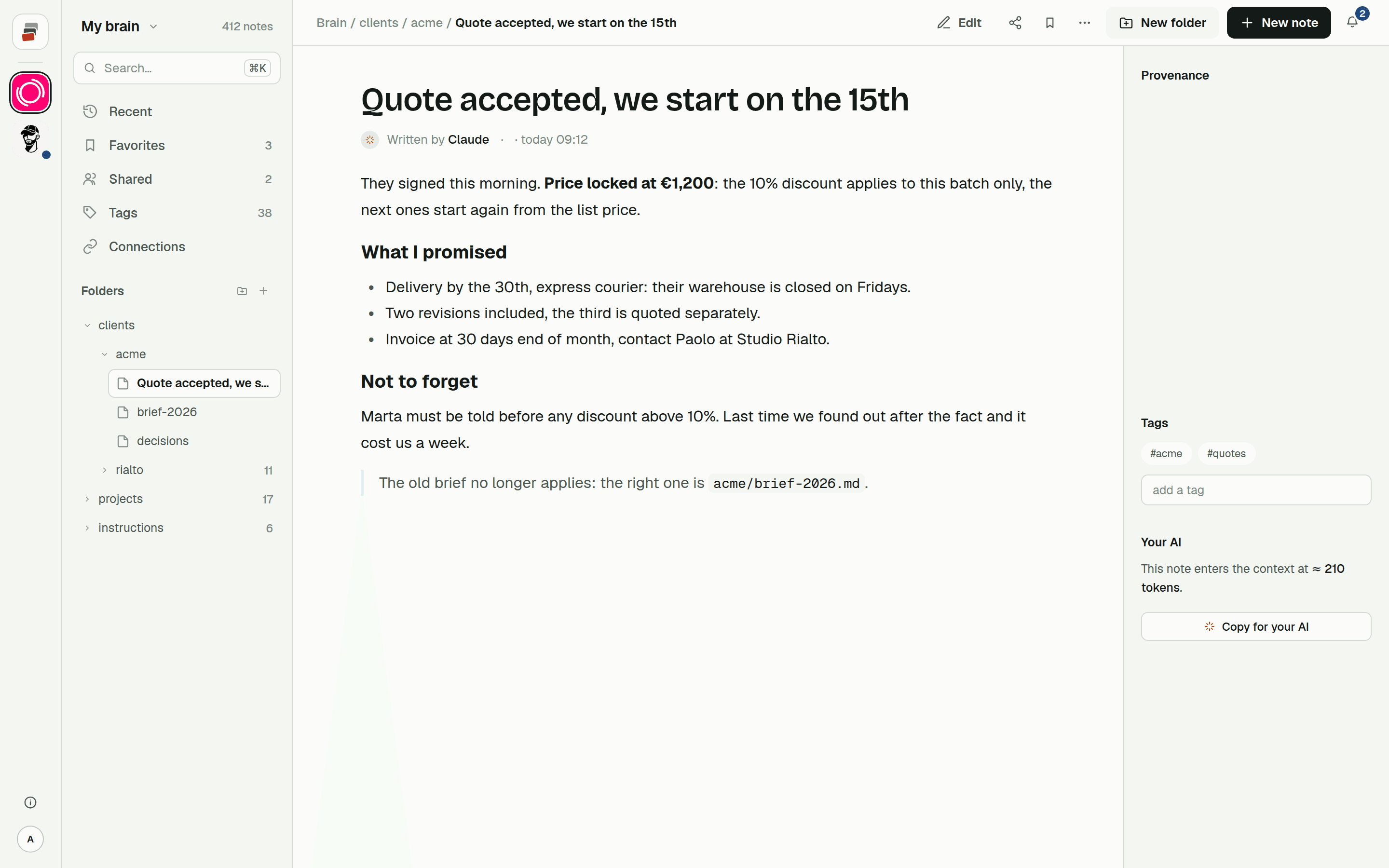
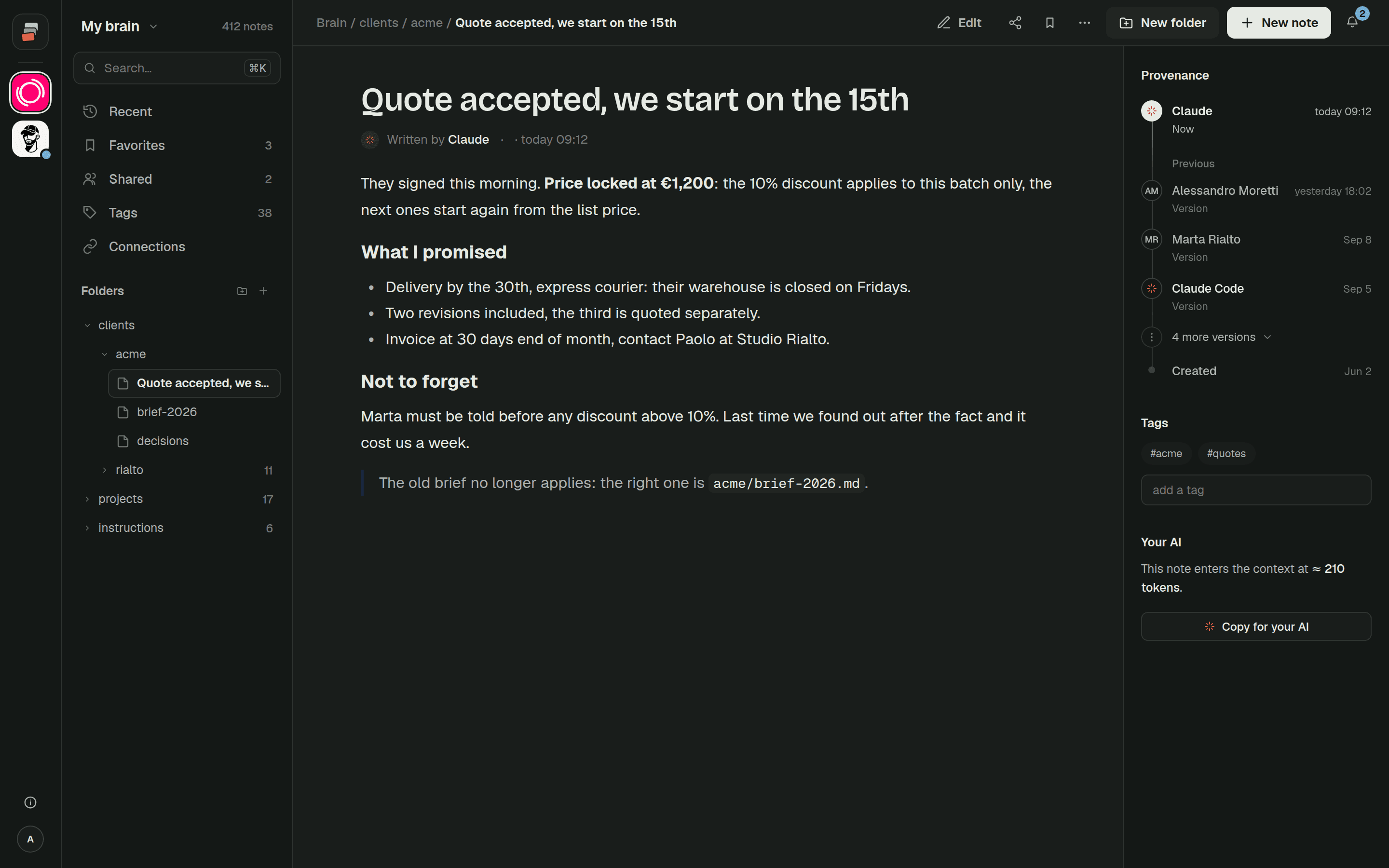
Then there's writing. A memory that only people update falls behind within a week. One that AIs update without saying who wrote what is hard to trust. What you want is the AI writing, with a signature: who changed the note, from which tool, and a way to go back.
Last, people should be able to read it too. Plain text in folders can be opened, corrected and exported. An internal summary that only the AI sees can't.
A week with three AIs and one memory
Say your team works for a client called Acme. On Monday you agree with Acme in a Claude chat that deliveries go by express courier, never on a Friday, and you ask Claude to write it down. It adds a line to the client's decisions note.
On Wednesday a colleague asks ChatGPT for the email about next week's delivery. ChatGPT opens the same note and writes "express courier, avoiding Friday" without anyone repeating it. On Friday the developer is updating the price list in Claude Code, asks whether Acme has pricing constraints, and finds the note in which someone else wrote that discounts above 10% need sign-off.
Nobody copied anything between apps. Each person kept using the AI they prefer, and the decision was there when it was needed.
How Cobrain fits
Cobrain is a shared memory built for that. Notes are Markdown files in folders, behind a remote MCP address that you connect to Claude, ChatGPT, Claude Code, Codex, Cursor and others. Connecting ChatGPT goes through a plugin that works on every plan, as the ChatGPT guide shows. Each AI works with your permissions, and every note shows who wrote it, you or one of your AIs, and the previous version can be brought back. Cobrain doesn't sync the internal memories of Claude or ChatGPT: it leaves them alone and gives every AI a better place to look.
For a team, the unit is the branch: a folder, with everything inside it, or a single note. You share it by email address with read or write access, and it appears in the other person's tree. Whoever receives never pays. On Pro one person besides you can write; for more, the Team plan adds a brain for the whole squad and a seat for each person. How the pieces fit is on Cobrain across AIs and Cobrain in a team.
Quick answers
Can Claude and ChatGPT share the same memory? Not on their own. Each keeps its memory inside its own app and per person. They can read the same notes if those notes sit behind an MCP server both are connected to.
Does a shared ChatGPT or Claude project give the team one memory? Within one product, partly: the files and instructions are shared. A Claude project is shared only within your organization on Team and Enterprise; a ChatGPT project can be shared with anyone you invite. Neither is visible to the other AI.
Can a Claude Team admin see what Claude remembers about each member? Anthropic says owners can't view or edit an individual's memories. Memory is retained and exportable by admins under the organization's chat data retention policies.
Do Claude Code and Codex read the same instructions? Claude Code reads CLAUDE.md and Codex reads AGENTS.md. You can keep one set of instructions for both, but those files describe how to work on the code, not what the team decided about a client.